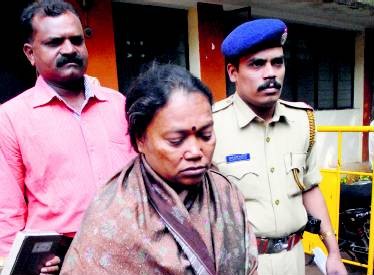





Forensic & Criminological Matrix
| Parameter | Forensic Detail |
|---|---|
| Forensic Heading / Aliases | Cyanide Mallika |
| Legal Identity | K. D. Kempamma |
| Confirmed Victims | 6 |
| Active Timeline | 1999 - 2007 |
| Jurisdiction / Area of Operations | Bangalore and outskirts, Karnataka, India |
| Criminological Classification | Profit-driven serial killer (Poisoner) |
| Forensic Modus Operandi | Luring victims at religious temples, simulating spiritual rituals, administering potassium cyanide covertly, and robbing gold jewelry and valuables |
| Weapon / Mechanism of Death | Potassium cyanide / Poisoning |
| Motive / Behavioral Dynamics | Financial enrichment to offset massive debts following a failed private savings scheme |
| Judicial Outcome | Sentenced to death in multiple cases, later commuted in part, with life imprisonment and ongoing legal appeals |
1. Background and Profile
K. D. Kempamma, widely known by the moniker "Cyanide Mallika," was born in India around 1970 and is recognized by criminologists as the first woman formally convicted as a serial killer in modern Indian judicial history. She resided in Kaggalipura, a village on the outskirts of Bangalore, Karnataka. She married a tailor employed at the National Institute of Mental Health and Neuro Sciences (NIMHANS) and raised children. Her socioeconomic trajectory shifted drastically in 1998 when a private rotating savings scheme (chit fund) that she operated collapsed. Faced with crippling debts, rejection by her family, and expulsion from her home, Mallika was forced into domestic labor and odd jobs, including assisting a local goldsmith, which likely exposed her to toxic industrial compounds.
2. Crime Spree and Modus Operandi
Mallika's modus operandi relied on psychological manipulation and the exploitation of religious devotion. Visiting Hindu temples around Bangalore, she targeted middle-aged women seeking spiritual solace who wore visible gold jewelry. Posing as a pious devotee, she would befriend them and invite them to secluded locations or outlying towns under the pretext of performing a special prayer ritual. During the ceremony, she offered her victims a sacred drink laced with potassium cyanide. Once death occurred via acute cardiorespiratory failure, Mallika systematically stripped the corpses of their gold ornaments and cellular devices, abandoning the remains in remote areas across districts such as Hoskote, Doddaballapur, Sathnur, Karatagere, and Maddur.
3. Investigation and Forensic Pursuit
The killing spree spanned from October 1999 to December 2007. Initially, the sudden deaths of middle-aged women on the city's periphery were treated as isolated incidents or attributed to natural causes, as cyanide poisoning mimics acute cardiovascular events unless specific toxicological screenings are conducted. Bengaluru police connected the homicides in late December 2007 by analyzing cellular phone records and tracking pawnshop transactions involving the victims' stolen jewelry. On December 31, 2007, Police Commissioner N. Achuta Rao announced the arrest of the 45-year-old suspect, who confessed during interrogation to murdering six women over the preceding eight years.
4. Legal Proceedings and Outcome
The legal proceedings against Kempamma unfolded across various courts in Karnataka, generating intense national media attention. She faced multiple trials for murder and armed robbery. In 2012, a sessions court sentenced her to death for the murder of Nagaveni, adding to a prior death sentence for the killing of Muniyamma and a life sentence for the murder of Pillamma. Over subsequent years, India's appellate courts modified several rulings; one death sentence was commuted to life imprisonment, and in 2017 the Karnataka High Court set aside a death penalty ruling in one case, ordering a retrial. She was subsequently transferred to Hindalga Central Prison in Belagavi.
5. Psychiatric Evaluation and Conclusion
Criminologically, Cyanide Mallika represents the archetype of a profit-driven serial offender where lethal violence serves strictly instrumental goals. Devoid of sexual or sadistic fantasies, her actions were governed by utilitarian calculation, leveraging spiritual trust for material gain. Psychological evaluations conducted during her imprisonment revealed an individual characterized by antisocial personality traits, profound lack of empathy, and high interpersonal cunning rather than clinical psychosis. Her case remains a landmark subject in Indian forensic science and legal scholarship regarding the detection and prosecution of female serial homicide.