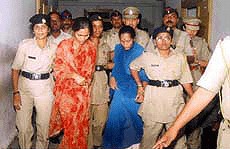






Forensic & Criminological Matrix
| Parameter | Forensic Detail |
|---|---|
| Forensic Heading / Aliases | Seema Gavit & Renuka Shinde (The Child-Killer Sisters) |
| Legal Identity | Seema Mohan Gavit |
| Confirmed Victims | 5 (suspected up to 9-13) |
| Active Timeline | 1990 - 1996 |
| Jurisdiction / Area of Operations | Maharashtra, India (Kolhapur, Pune, Nashik, Thane) |
| Criminological Classification | Lucrative Serial Killer / Criminal Exploitation |
| Forensic Modus Operandi | Systematic abduction of toddlers in crowded environments to mask pickpocketing and petty crime. Elimination of children via severe blunt-force trauma (smashing heads against walls or poles) when they aged out or became liabilities. |
| Weapon / Mechanism of Death | Direct physical trauma, cranial impact against rigid surfaces, starvation, and asphyxiation |
| Motive / Behavioral Dynamics | Financial gain through child exploitation and familial clannish psychopathology originating from personal vendetta |
| Judicial Outcome | Sentenced to death by the Kolhapur Sessions Court (2001); upheld by the Bombay High Court (2004) and the Supreme Court of India (2006) |
1. Background and Profile
Seema Gavit belonged to a violently dysfunctional, matriarchal criminal clan in Maharashtra, India. Raised under the direct influence of her mother Anjanabai Gavit—a career criminal with over a hundred petty theft and pickpocketing cases—Seema and her sister Renuka Shinde were immersed in urban delinquency from an early age. The catalyst for their escalation into serial homicide occurred in 1990 when their father, Mohan Gavit, abandoned the family to marry another woman, Pratima. Driven by a vengeful desire for retribution and an utter disregard for human life, Anjanabai and her daughters plotted to abduct the patriarch's child with his new wife, igniting a six-year spree of child abduction and murder.
2. Crime Spree and Modus Operandi
The sisters' methodology relied on calculated deception. Posing as ordinary mothers, they frequented crowded railway terminals, bus stations, temples, and markets across Nashik, Pune, and Kolhapur carrying young toddlers. This setup allowed them to blend into crowds and distract onlookers while executing purse-snatching and pickpocketing.
However, when the kidnapped children outgrew their usefulness as human shields, or if they cried in public and threatened to expose the gang, they were murdered with chilling detachment. In one documented instance, an 18-month-old boy named Santosh began crying at a bus stand; fearing discovery, the women repeatedly smashed his head against the floor and an iron pole until he died. In another case, a three-year-old named Pankaj was hung upside down from the ceiling and repeatedly slammed against a wall for talking to passers-by about his parents.
3. Investigation and Arrest
The crimes went undetected for nearly six years due to the isolated nature of the victims and the clan's tactical concealment of bodies. The investigation reached a breakthrough in October 1996 when the sisters targeted their 14th victim—who happened to be their second step-sister. This failed abduction triggered a police response that led to the immediate arrest of Seema, Renuka, their mother Anjanabai, and Renuka's husband, Kiran Shinde.
The prosecution's case was solidified when Kiran Shinde turned approver, providing authorities with a detailed forensic account of the torture, abuse, and systematic murder of the children.
4. Legal Proceedings and Outcome
Following their 1996 arrest, matriarch Anjanabai Gavit died in Yerwada Prison in 1997 prior to trial. Formal proceedings against the sisters commenced in September 1998 before Kolhapur Additional Sessions Judge G.L. Yedke. In 2001, the court delivered a landmark verdict sentencing both women to death for five proven murders, while charges against Kiran Shinde were dropped.
Appeals through the judicial hierarchy failed: the Bombay High Court confirmed the death sentences in September 2004, and the Supreme Court of India, led by Justices K.G. Balakrishnan and G.P. Mathur, upheld the ruling in August 2006. The apex court categorized the crimes under the 'rarest of the rare' doctrine, citing the extreme moral depravity of the convicts and the absence of mitigating factors.
5. Psychiatric Evaluation and Aftermath
Forensic psychiatrists and appellate judges characterized Seema Gavit and her sister as exhibiting severe psychopathic traits marked by the instrumentalization of infants, absence of remorse, and deep-seated criminal socialization. The courts concluded that neither woman was capable of rehabilitation and both remained a permanent menace to society, making their case a landmark reference point in debates regarding capital punishment for female offenders in India.