



Alexander Pearce: «The Van Diemen's Land Cannibal» and the Sarah Island Wilderness
Executive Summary
Alexander Pearce (1790 – 1824) was an Irish convict transported to the penal settlements of Van Diemen's Land (present-day Tasmania, Australia), whose exploits became one of the most horrific founding legends in Australian criminology. He is remembered for staging two escapes from the penal outpost of Sarah Island across the unexplored Tasmanian wilderness, surviving both journeys through systematic, premeditated cannibalism of his fellow escapees.
Originally convicted in Armagh and sentenced to seven years' transportation for stealing six pairs of shoes, Pearce's incorrigible defiance resulted in his banishment to the Macquarie Harbour penal station. In September 1822, he escaped into the rainforest alongside seven convicts aiming for Hobart across mountain ranges. When provisions ran out on the eighth day, the party engaged in a chain of survival murders, executing companions one by one with a timber felling axe. The ordeal concluded in a battle of attrition between Pearce and the last survivor, Robert Greenhill: after stalking each other across the campfire for days without daring to sleep, Pearce seized an opportunity when Greenhill dozed to crush his skull with the axe.
Recaptured after 113 days, colonial magistrate Robert Knopwood disbelieved his confession, dismissing it as an invention to shield fugitive accomplices, and returned Pearce to Sarah Island. Just a year later, in November 1823, Pearce escaped again with convict Thomas Cox; within ten days he was recaptured along the King River carrying roasted pieces of Cox's flesh in his pockets despite having untouched rations of pork and bread. Tried before the Supreme Court of Van Diemen's Land, he was hanged in Hobart and his body was delivered to medical authorities for anatomical dissection.
Forensic & Criminological Matrix
| Parameter | Forensic Detail |
|---|---|
| Legal Identity | Alexander Pearce (recorded as Pierce in colonial records) |
| Date of Birth | 1790 (County Fermanagh, Kingdom of Ireland) |
| Date of Death | July 19, 1824 (Aged 34; executed by hanging in Hobart, Tasmania) |
| Criminological Classification | Colonial Convict / Survival Cannibalism / Murder by Ambush |
| Direct Fatalities | Robert Greenhill (1st escape) and Thomas Cox (2nd escape); accomplice in 4 prior killings |
| Geographic Locations | Sarah Island, Macquarie Harbour, Gordon River, and Western Tasmanian Wilderness |
| Murder Weapons | Felling axe and hunting knife |
| Presiding Magistrates | Reverend Robert Knopwood and Chief Justice Sir John Lewes Pedder |
| Anatomical Destination | Body dissected; skull sold to American craniologist Dr. Samuel George Morton |
| Judicial Disposition | Hanged at Hobart Gaol on July 19, 1824 |
From Ireland to Macquarie Harbour (1790–1822)
Alexander Pearce was born in County Fermanagh, Ireland, working as an illiterate agricultural laborer. In 1819, at the Armagh Assizes, he was convicted of stealing six pairs of shoes. Under the British Bloody Code, he received seven years' penal transportation.
In 1820, he arrived in Hobart aboard the convict transport Castle Forbes. Incorrigible under forced labor, Pearce accumulated floggings for drunkenness, forged passes, and absconding. In May 1822, colonial authorities transferred him to the newly established Macquarie Harbour penal station on Tasmania's west coast:
- Sarah Island was a penal purgatory surrounded by freezing waters and dense rainforest, reserved for the empire's most recalcitrant convicts.
- Convicts felled Huon pine logs waist-deep in freezing water under military overseers. Land escape was deemed impossible due to impassable terrain and harsh weather.
The First Escape: Chain of Sacrifices (September – December 1822)
On September 20, 1822, while working in a logging gang across the harbor, Pearce and seven convicts overpowered their overseer, seized an axe, and fled eastward into the wilderness:
- The party: Alexander Pearce, Robert Greenhill (mariner), Matthew Travers (Greenhill's associate), Thomas Bodenham, Alexander Dalton, John Mather, and William Kennerly.
The Descent into Anthropophagy
After eight days marching through freezing rain, provisions ran out. Starvation prompted Greenhill, Travers, and Pearce to form a survival pact:
- Thomas Bodenham: Exhausted, Bodenham collapsed to rest; Greenhill felled him with an axe blow to the head. The body was butchered and consumed.
- The Deserters: Horrified, John Mather and William Kennerly abandoned the group, attempting to backtrack to Macquarie Harbour; both died of exposure.
- Alexander Dalton: Dalton, who opposed cannibalism, was killed in his sleep by Greenhill and Travers to feed the remaining four men.
- Matthew Travers: Travers was bitten by a venomous tiger snake. Pearce and Greenhill carried him for days as gangrene climbed his leg. Begging for release from agony, Travers was killed by Greenhill, and his flesh was consumed.
The Standoff: Pearce vs. Greenhill
By late October 1822, only Pearce and Greenhill survived:
- Both men recognized that whoever slept first would be butchered by the other.
- Greenhill kept the axe; Pearce held a pocket knife.
- For four days and nights they sat across the campfire, staying awake through pain and terror.
- On the fourth night, Greenhill collapsed from exhaustion. Pearce snatched the axe and split Greenhill's skull. Taking portions of the body, Pearce proceeded alone.
Recapture, Colonial Skepticism, and Second Escape (1823)
Pearce reached the Derwent Valley after 113 days, joining bushranger William "Cowboy" Davis until captured by military patrols.
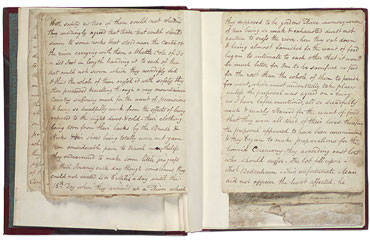
Examined by magistrate Reverend Robert Knopwood, Pearce confessed to the cannibalism, asking to be hanged:
- Knopwood dismissed the account as a fabricated fiction designed to protect Greenhill and the others whom he assumed were still active bushrangers.
- Lacking physical proof of corpses, Knopwood remanded Pearce back to Sarah Island to serve his original sentence.
Escape with Thomas Cox (November 1823)
On November 16, 1823, Pearce convinced convict Thomas Cox to escape toward the King River.
Ten days later, Pearce signaled soldiers from the riverbank, surrendering voluntarily:
- In his pockets, guards discovered roasted human flesh, despite his knapsack containing pork and bread.
- Pearce led soldiers to Cox's butchered body. Asked why he killed Cox when he had provisions, Pearce replied: "Human flesh is delicious; it tastes far better than fish or pork."
Trial, Gallows, and the Craniological Legacy
On June 20, 1824, Pearce was tried before Chief Justice Sir John Lewes Pedder in Hobart:
- With the physical remains of Cox verified by surgeons, guilt was incontrovertible.
- Pearce was sentenced to death by hanging.
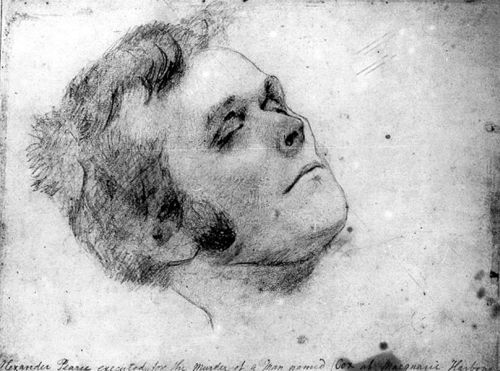
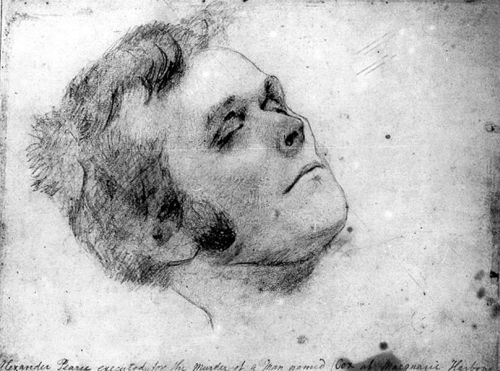
On July 19, 1824, Alexander Pearce was executed at Hobart Gaol. His corpse was delivered for public dissection. Surgeon William Crowther excised Pearce's skull, selling it to American physician Samuel George Morton for his craniological collection at the University of Pennsylvania, where it remains cataloged as «Alexander Pearce, The Tasmanian Cannibal».