



Armin Meiwes: «The Cannibal of Rotenburg» and Consensual Homicide
Executive Summary
In March 2001, in the town of Rotenburg an der Fulda (Hesse, Germany), Armin Meiwes, a 39-year-old computer repair technician and former German army sergeant, committed one of the most disturbing and legally complex crimes in European history: the murder, dismemberment, and cannibalism of Bernd Jürgen Brandes (43), an engineer from Berlin who voluntarily traveled to Meiwes's manor after answering an advertisement posted on clandestine internet message boards.
The encounter, recorded in its entirety on a four-hour video cassette that served as central forensic evidence, concluded with the evisceration and freezing of more than 20 kilograms of human tissue, which Meiwes consumed over subsequent months. His arrest in December 2002—prompted by an Austrian student who spotted new solicitations online—confronted German jurisprudence with a unique legal vacuum: the penal code contained no specific statute criminalizing cannibalism, and the victim had given explicit, documented consent to his slaughter.
Following an initial 2004 conviction for manslaughter (Totschlag) with an eight-and-a-half-year prison sentence, the Federal Court of Justice (Bundesgerichtshof) overturned the verdict, ruling that consent to be slaughtered to satisfy a sexual paraphilia is null and void under German constitutional law. In May 2006, the Frankfurt Regional Court convicted Meiwes of murder (Mord) with sexual motivation, sentencing him to life imprisonment.
Forensic & Criminological Matrix
| Parameter | Forensic Detail |
|---|---|
| Legal Identity | Armin Meiwes |
| Criminological Monikers | "The Cannibal of Rotenburg" / "Der Metzgermeister" (The Master Butcher) |
| Date of Birth | December 1, 1961 (Essen, North Rhine-Westphalia, Germany) |
| Age at Crime | 39 years old |
| Criminological Classification | Paraphilic Serial/Spree Killer / Consensual Anthropophagy / Extreme Vorarephilia |
| Fatal Victim | Bernd Jürgen Armando Brandes (43; Siemens engineer from Berlin) |
| Date of Crime | Night of March 9–10, 2001 |
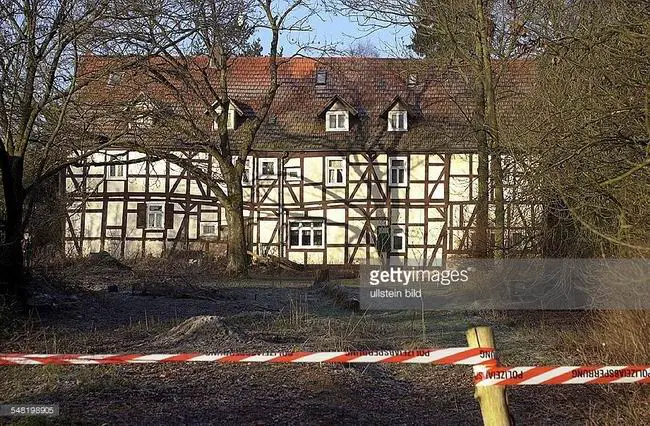
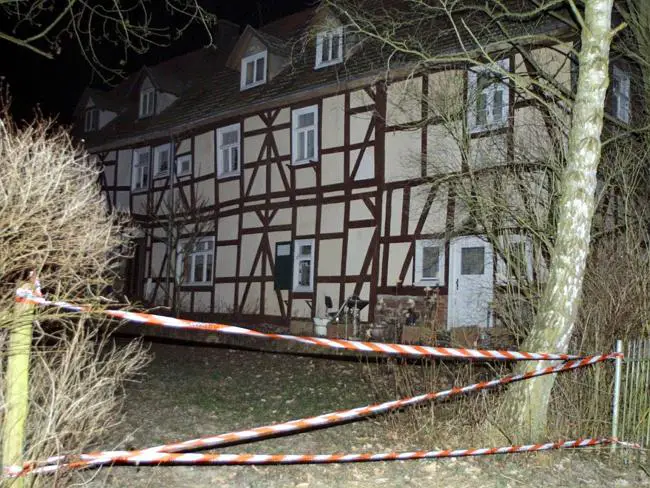
| Crime Scene | Family manor in Wüstefeld, Rotenburg an der Fulda (Hesse, Germany) |
| Primary Forensic Evidence | 4-hour videotape documenting the complete ritual |
| Judicial Disposition | Life Imprisonment (Lebenslange Freiheitsstrafe) imposed by Frankfurt Court in 2006 |
| Current Incarceration | High-security facility at Diez Prison (Rhineland-Palatinate) |
Psychopathology: Vorarephilia and the Imaginary Brother
Armin Meiwes grew up in an isolated rural manor in Wüstefeld under a domineering mother after his father and brothers deserted the family. In childhood he developed a fixation on the Brothers Grimm fairy tale «Hansel and Gretel», specifically the witch's desire to fatten and consume the boy.
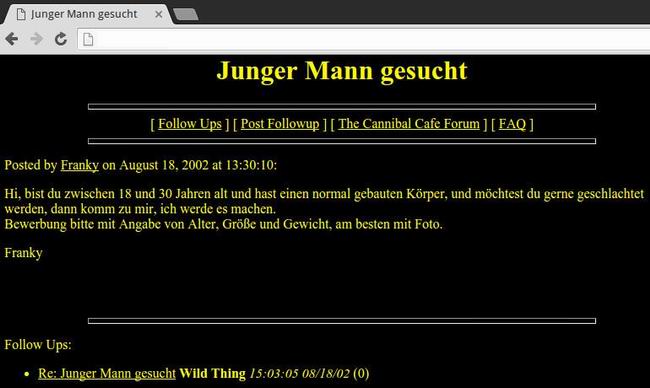
In adolescence, intense loneliness led him to invent an imaginary younger brother named «Frankie», associating bodily consumption with absolute physical union. Following twelve years of service in the German Army (Bundeswehr) as a communications sergeant and his mother's death in 1999, Meiwes turned to online cannibal forums under the pseudonym «Franky»:
"Seeking well-built young man, aged 18 to 30, willing to be slaughtered and consumed."
In early 2001, he made contact with Bernd Jürgen Brandes, posting under the handle «Cator», who harbored a long-standing masochistic compulsion toward genital mutilation and physical destruction.
The Night of March 9–10, 2001
On the evening of March 9, 2001, Brandes arrived by train at Bad Hersfeld station, where Meiwes picked him up and drove to Wüstefeld:
- The Slaughter Room: Meiwes had converted an attic room into a butchering suite lined with plastic sheeting, meat hooks, and a camcorder on a tripod.
- Sedation: Brandes consumed twenty sleeping tablets and half a bottle of schnapps to dull physical agony.
- Mutilation: Following mutual agreement, Meiwes amputated Brandes's genitalia with a kitchen knife. The two men attempted to fry and consume the flesh together in the kitchen before Brandes lost consciousness from blood loss.
- The Homicide: At 04:00 on March 10, after checking Brandes lying unconscious in the bathtub, Meiwes stabbed him fatally in the left side of the neck with a butcher's knife.
- Dismemberment: Meiwes dissected the corpse, packaging over 20 kilograms of muscle into freezer bags labeled as steaks, burying the skull and bones in the garden.
Cyber Investigation and Arrest (December 2002)
Over the following twenty months, Meiwes maintained his routine as a computer technician while consuming the stored human meat. In November 2002, with supplies dwindling, he posted new messages seeking another volunteer.
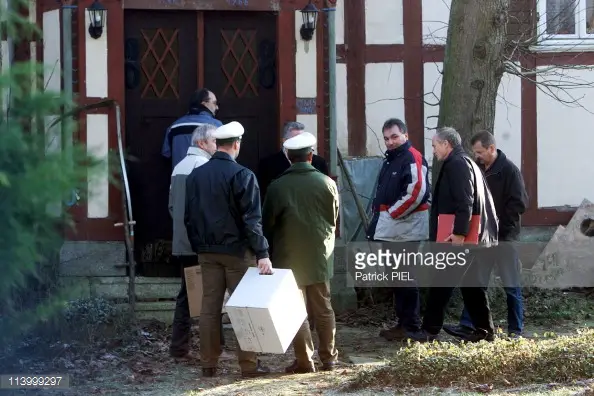
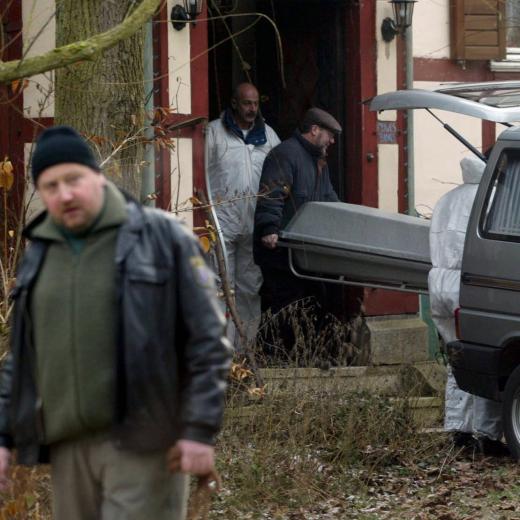
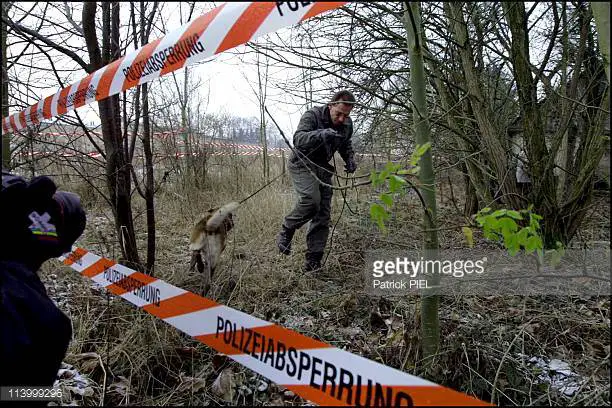
An Austrian university student alerted Vienna police (Bundeskriminalamt), who forwarded the lead to Germany's Federal Criminal Police Office (BKA). On December 10, 2002, police raided the Wüstefeld manor, discovering human remains in the freezer, garden graves, and the videotapes labeled on a bookshelf.
Legal Controversy and the Two Trials
The case challenged European criminal legal theory:
- Absence of Specific Statute: German penal law (StGB) lacked a specific provision criminalizing adult cannibalism.
- Consensual Killing Argument: The defense argued Brandes sought his own death (Tötung auf Verlangen, Section 216 StGB), which carried a maximum five-year penalty.
First Trial (Kassel, 2003–2004)
In January 2004, the Kassel District Court convicted Meiwes of manslaughter (Totschlag), imposing an eight-and-a-half-year sentence, declining to find murder due to the victim's consent.
Federal Court Reversal and Retrial (Frankfurt, 2006)
Federal prosecutors appealed. In April 2005, the Federal Court of Justice (Bundesgerichtshof) quashed the verdict in a landmark decision: ruling that consent to be slaughtered to satisfy a sexual paraphilia is legally invalid under the German Basic Law (Grundgesetz).
Retried in Frankfurt, on May 9, 2006, the court sentenced Armin Meiwes to Life Imprisonment for murder (Mord) with sexual motivation. Incarcerated at Diez Prison, his periodic parole petitions have been repeatedly denied.