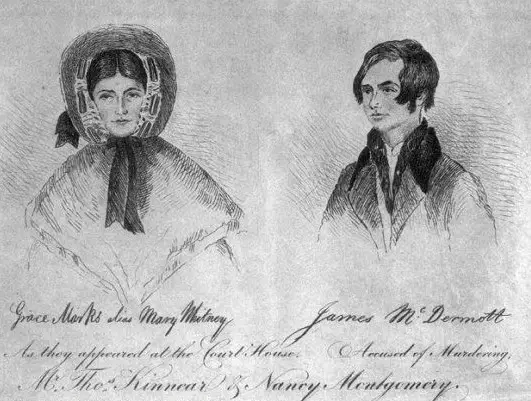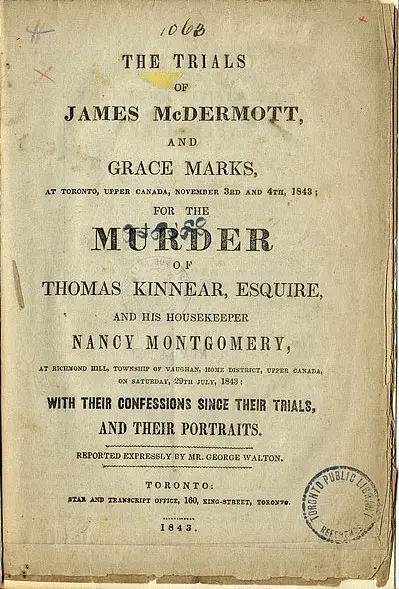






Forensic & Criminological Matrix
| Parameter | Forensic Detail |
|---|---|
| Forensic Heading / Aliases | Grace Marks / Mary Whitney |
| Legal Identity | Grace Marks |
| Confirmed Victims | 2 (Thomas Kinnear and Nancy Montgomery) |
| Active Timeline | July 1843 |
| Jurisdiction / Area of Operations | Richmond Hill, Ontario, Canada |
| Criminological Classification | Accomplice / Historic Judicial Enigma |
| Forensic Modus Operandi | Conspiratorial homicide involving blunt force trauma via ax and subsequent manual ligature strangulation |
| Weapon / Mechanism of Death | Hand ax and scarf ligature |
| Motive / Behavioral Dynamics | Domestic hierarchy conflicts, workplace resentment, and alleged mutual psychological coercion |
| Judicial Outcome | Sentenced to death in 1843, commuted to life imprisonment, temporarily institutionalized for insanity, pardoned in 1873 after nearly 30 years of incarceration |
1. Background and Profile
Grace Marks was born in Northern Ireland around 1828 and immigrated to Canada with her family during her early teens. Following hardships and the loss of her mother during the voyage, she entered domestic service to secure a livelihood. Employed as a maid at the estate of Thomas Kinnear in Richmond Hill, Ontario, she crossed paths with fellow servant James McDermott, developing a volatile relationship fueled by shared grievances against Kinnear's housekeeper, Nancy Montgomery.
2. Crime Spree
In July 1843, domestic tensions culminated in a premeditated conspiracy. While Kinnear was temporarily away, McDermott bludgeoned Nancy Montgomery with an ax and concealed her body in the cellar. Upon discovering she was still breathing, Marks and McDermott finished the killing by strangling her with a scarf. When Kinnear returned later that day, he was ambushed and fatally shot by McDermott in the kitchen. The pair gathered valuables and cash before attempting flight toward the United States.
3. Investigation and Arrest
Law enforcement mounted a swift response following the discovery of the crime scene. Marks and McDermott's attempt to escape was thwarted when authorities tracked and apprehended them in Toronto as they attempted to board a steamer bound for New York, recovering stolen valuables in their possession.
4. Legal Proceedings and Outcome
Trials in November 1843 captured widespread public attention in Upper Canada. James McDermott was convicted of Kinnear's murder and hanged on November 21, 1843. Grace Marks was convicted the following day; although sentenced to death, the jury recommended mercy due to her youth and ambiguous role in the direct violence. Her sentence was commuted to life imprisonment at Kingston Penitentiary.
5. Psychiatric Evaluation and Final Disposition
After more than eight years of imprisonment, Marks exhibited severe psychiatric symptoms, including acute emotional instability and vivid hallucinations, leading to her transfer to the Toronto Lunatic Asylum as one of Canada's earliest recognized 'criminal lunatics.' Returned to Kingston Penitentiary after treatment, she served nearly twenty additional years before receiving a full pardon in 1873. Following her release, she relocated to New York under the alias Mary Whitney, after which all reliable historical records ceased.