




Forensic & Criminological Matrix
| Parameter | Forensic Detail |
|---|---|
| Forensic Heading / Aliases | Frederick 'Fred' W. Edel |
| Legal Identity | Fritz Wilhelm Edel |
| Confirmed Victims | 1 |
| Attributed / Indicted Victims | 4 |
| Active Timeline | 1921 - 1927 |
| Jurisdiction / Area of Operations | New York and Connecticut, United States |
| Criminological Classification | Suspected Serial Killer / Murderer for Profit |
| Forensic Modus Operandi | Home entry via deception (furniture ads) and appropriation of assets post-homicide |
| Weapon / Mechanism of Death | Hammer, iron bar (blunt force trauma) and suspected shooting |
| Motive / Behavioral Dynamics | Financial gain and delusional justification |
| Judicial Outcome | Death sentence (commuted to life imprisonment) |
1. Background and Profile
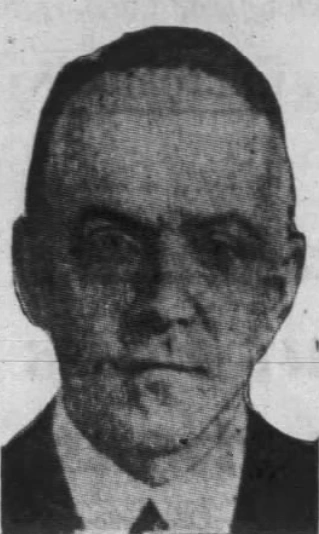
Frederick Wilhelm Edel was a German national, born Fritz Wilhelm Edel in 1891 in Saxony, Germany, who committed a series of crimes in the United States during the 1920s. He is noted for his long-term evasion of law enforcement before his eventual apprehension. His background as an immigrant in New York provided him with a degree of anonymity that he exploited during his criminal career. Edel was a habitual criminal with a significant record; in 1921, he was convicted of robbery in New York and served a five-year term at Dannemora State Prison before escalating to lethal violence in 1926.
2. Criminal Career and Modus Operandi
Edel's criminal activity centered on the confirmed homicide of actress Emeline Harrington, though he remains a prime suspect in additional cases in Meriden, Connecticut. On December 24, 1926, he was linked to the shooting of innkeeper John Mastriano, and on March 23, 1927, he was connected to the shooting death of David Dudley.
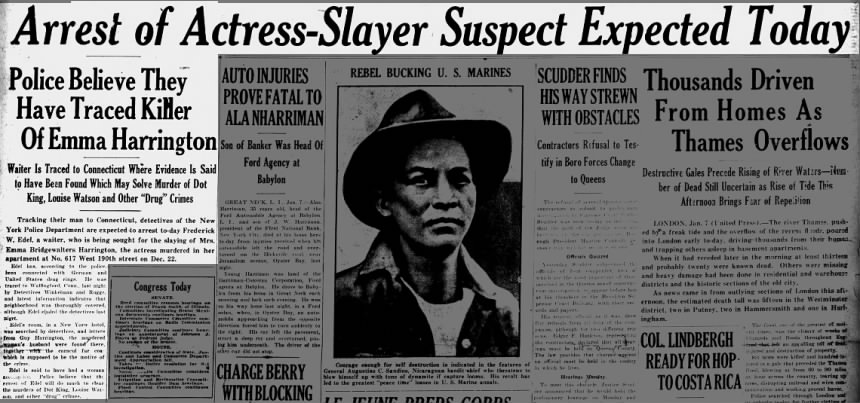
His specific modus operandi involved responding to classified advertisements where victims offered furniture for sale. This ruse allowed him to enter homes without suspicion. On the afternoon of December 23, 1927, he murdered Emeline Harrington in her apartment at 617 West 190th Street using a hammer and an iron bar. Following the crime, he seized the victim's jewelry and clothing, later claiming in court that these items were voluntary gifts. Forensic evidence also suggested he had attacked and robbed another woman in West 181st Street just one month prior using the same furniture-sale pretext.
3. Investigation and Arrest
Law enforcement agencies pursued Edel as he moved between jurisdictions. A major breakthrough occurred on January 2, 1928, when Edel fled the Taft Hotel in New Haven, Connecticut, leaving an unpaid bill. Detectives Winkelman and Roge uncovered Harrington's coat and an iron bar in his room.
Following his arrest in Minnesota, Edel gave a formal statement in St. Paul on March 27, 1928, to Assistant District Attorney John F. McGowan and Postoffice Inspector Adrian Anderson. He confessed that he had carried a suitcase containing Harrington's clothes and the murder hammer around New York for six days while her body remained undiscovered. He claimed a chauffeur delivered the bag to him at the Pennsylvania Hotel. He then traveled to Springfield and New Haven with two female companions, giving them the victim's jewelry as gifts. The arrest of these women led to the recovery of the stolen property. Edel was eventually held by federal postal inspectors for money order forgery before being extradited to New York for murder.
4. Legal Proceedings and Outcome
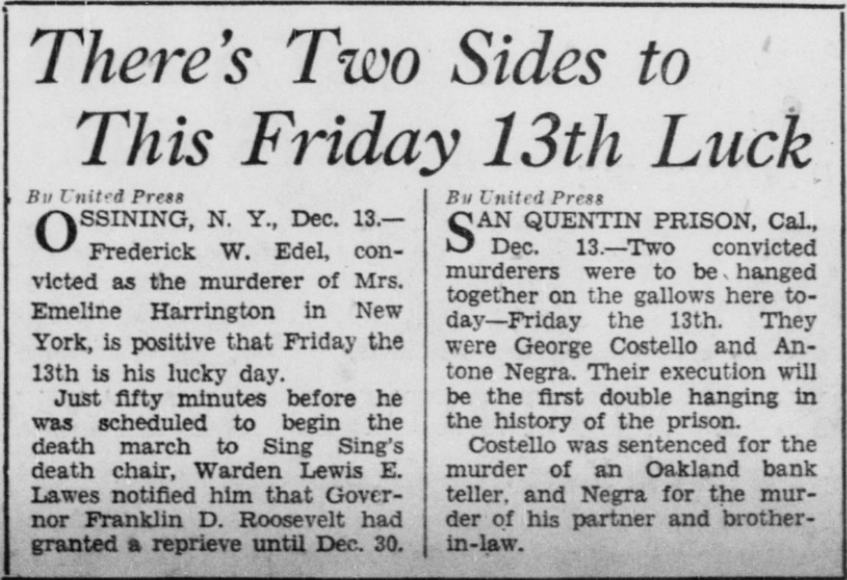
Edel was brought to trial in March 1929 at the Court of General Sessions in New York. The prosecution, led by James E. McDonald, presented overwhelming circumstantial evidence. In February 1929, the court heard Edel's St. Paul statement where he claimed to have known Harrington since 1920 and to have dated her six times, a claim the prosecution dismissed as a fabrication. Inspector Anderson testified that Edel had personally identified the stolen jewelry and toilet articles recovered in Massachusetts and Connecticut. Federal authorities had initially threatened to prosecute him for postal fraud—carrying a potential 100-year sentence—unless New York could guarantee a murder conviction. On March 7, 1929, after four and a half hours of deliberation, the jury returned a verdict of murder in the first degree. Judge Nott sentenced him to the electric chair at Sing Sing. Appeals delayed the execution until March 29, 1930, when Governor Franklin Roosevelt commuted Edel's sentence to life imprisonment.
5. Psychiatric Evaluation and Final Years
During his trial, Edel's statements showed a profound lack of remorse and a delusional justification for his actions, famously stating, "She sent her jewels and clothing to me as a gift." He boasted about his numerous conquests of women, displaying a narcissistic personality. He remained incarcerated for several decades until he was granted parole on the condition of deportation. Records indicate that he eventually died of natural causes in West Berlin, Germany, in early March 1962, at the age of 72. His case remains a significant example of early 20th-century forensic investigation into profit-motivated homicides.