Forensic & Criminological Matrix
| Parameter | Forensic Detail |
|---|---|
| Forensic Heading / Aliases | None |
| Legal Identity | Jesus Romero Jr. |
| Confirmed Victims | 1 |
| Attributed / Indicted Victims | 1 |
| Active Timeline | 1984 |
| Jurisdiction / Area of Operations | San Benito, Texas, USA |
| Criminological Classification | Gang-related sexual murderer |
| Forensic Modus Operandi | Abduction, rape, blunt force trauma, and stabbing |
| Weapon / Mechanism of Death | Metal pipe and knife |
| Motive / Behavioral Dynamics | Sexual violence and witness elimination |
| Judicial Outcome | Death penalty via lethal injection |
1. Background and Psychopathy
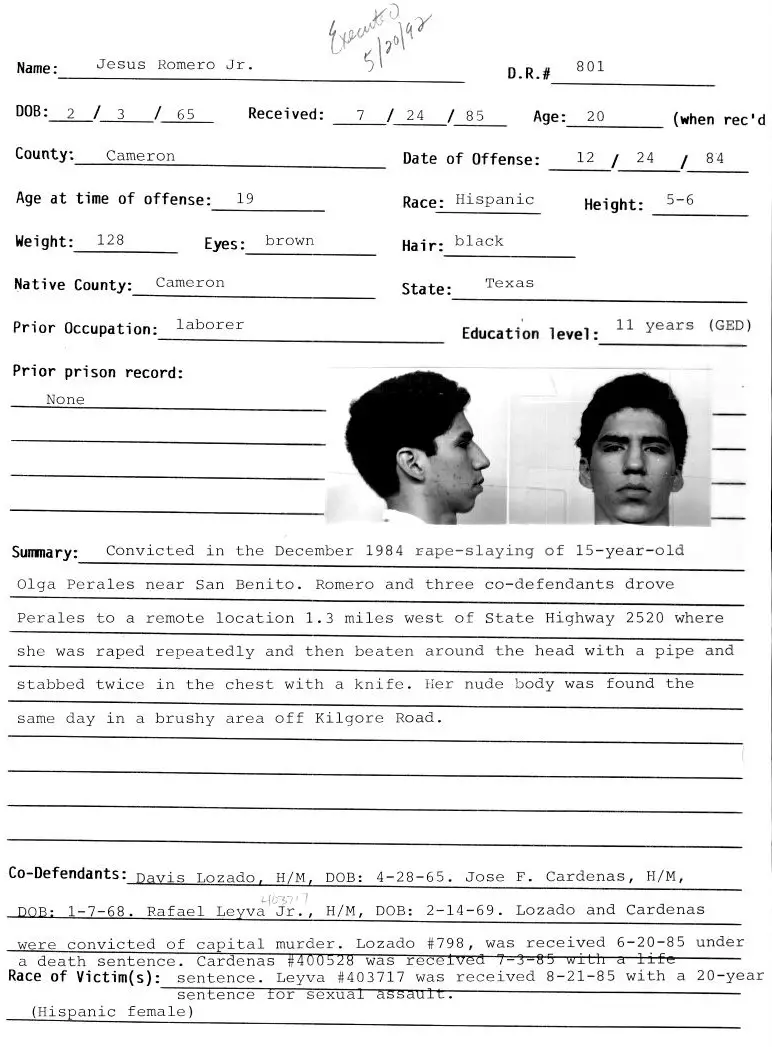
Jesus Romero Jr. (1965–1992) was a former migrant worker with a prior criminal history, including a 10-year sentence for aggravated sexual assault. He had been committed twice to mental health facilities in San Benito. During his trial, conflicting psychiatric testimony regarding schizophrenia was presented, though the jury ultimately rejected these claims as mitigating factors.
2. Crime Spree
On December 23, 1984, Romero and three associates—David Lozado, Jose Cardenas, and Rafael Leyva Jr., all members of the 'La Cliqua' gang—abducted 15-year-old Olga Lydia Perales. After consuming alcohol and marijuana, they drove her to a remote area called La Piedra. There, the victim was subjected to a gang rape, followed by a brutal beating with a metal pipe and multiple stab wounds to ensure her death.
3. Investigation and Arrest
Law enforcement broke the case when Rafael Leyva Jr. confessed to his juvenile probation officer on January 8, 1985. His testimony provided the framework for the prosecution. Forensic evidence, including blood-stained underwear recovered from Romero's home, provided physical corroboration of the crime.
4. Legal Proceedings and Outcome
Romero was sentenced to death on July 19, 1985. His appeals focused on ineffective assistance of counsel and the failure to present mitigating evidence regarding his youth and mental state. Despite multiple federal habeas corpus petitions and stays of execution, the Fifth Circuit Court of Appeals ultimately affirmed the conviction and sentence. Romero was executed by lethal injection on May 20, 1992.