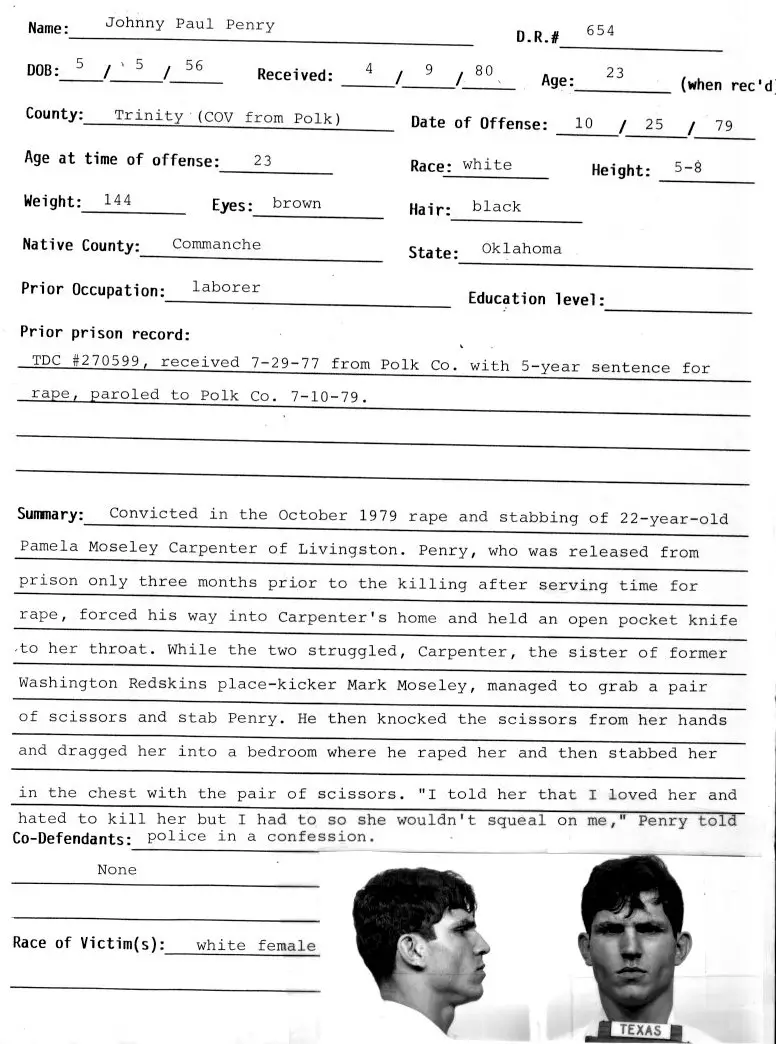
Forensic & Criminological Matrix
| Parameter | Forensic Detail |
|---|---|
| Forensic Heading / Aliases | N/A |
| Legal Identity | Johnny Paul Penry |
| Confirmed Victims | 1 |
| Attributed / Indicted Victims | 1 |
| Active Timeline | 1977-1979 |
| Jurisdiction / Area of Operations | Livingston, Polk County, Texas |
| Criminological Classification | Sexual murderer / Serial rapist |
| Forensic Modus Operandi | Deceptive entry, armed intimidation, and sexual assault |
| Weapon / Mechanism of Death | Pocket knife and scissors |
| Motive / Behavioral Dynamics | Sexual impulsivity, robbery, and witness elimination |
| Judicial Outcome | Life imprisonment without parole |
1. Background and Profile
Born on May 5, 1956, Johnny Paul Penry had a documented history of violent crime, including a 1977 rape conviction. His legal journey is defined by prolonged litigation regarding his mental capacity. Defense attorneys consistently argued he possessed the reasoning capability of a seven-year-old, a claim repeatedly scrutinized and rejected by multiple juries and the U.S. Supreme Court.
2. Crime Spree
On October 25, 1979, Penry targeted Pamela Moseley Carpenter, whom he had encountered earlier while working as an appliance installer. He forced his way into her home at knifepoint. During the struggle, Carpenter managed to stab Penry with a pair of scissors. Penry subsequently raped her and, fearing she would report him, murdered her by stabbing her in the chest with the same scissors.
3. Investigation and Arrest
Before succumbing to her injuries, Carpenter provided a description of her attacker to medical personnel. Police apprehended Penry shortly thereafter, noting puncture wounds on his back consistent with the victim's account. After initially fabricating an alibi involving a bicycle accident, Penry confessed to the rape and murder.
4. Legal Proceedings and Outcome
Sentenced to death in 1980, Penry's case became a focal point for the U.S. Supreme Court regarding the death penalty and intellectual disability. Following three overturned death sentences, Penry entered a plea agreement on February 15, 2008, accepting a sentence of life without parole. He ratified findings that he did not meet the legal definition of intellectual disability.