




Forensic & Criminological Matrix
| Parameter | Forensic Detail |
|---|---|
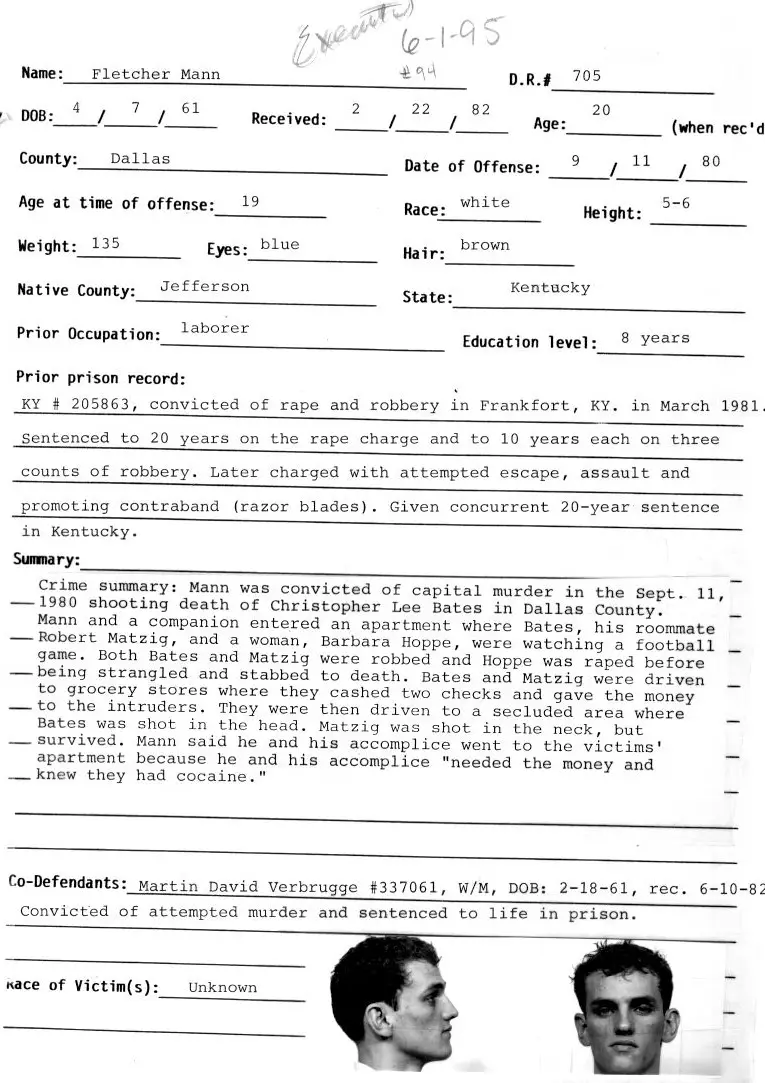
| Forensic Heading / Aliases | Tommy |
| Legal Identity | Fletcher Thomas Mann |
| Confirmed Victims | 2 |
| Attributed / Indicted Victims | 2 |
| Active Timeline | September 11, 1980 |
| Jurisdiction / Area of Operations | Dallas, Texas, USA |
| Criminological Classification | Multiple Murderer |
| Forensic Modus Operandi | Home invasion, robbery, rape, strangulation, and execution-style shooting |
| Weapon / Mechanism of Death | .38 caliber revolver, knife, physical force |
| Motive / Behavioral Dynamics | Financial gain (theft of money and cocaine) and witness elimination |
| Judicial Outcome | Death penalty via lethal injection |
1. Background and Psychopathy
Fletcher Thomas Mann (born April 7, 1961) exhibited a pattern of severe antisocial behavior. His criminal history was defined by drug abuse and violent predatory acts. While incarcerated on death row, he expressed admiration for Charles Manson, reflecting a deep-seated alignment with violent criminal ideologies.
2. Crime Spree
On September 11, 1980, Mann and his accomplice, Martin David Verbrugge, invaded a Dallas apartment. They held Christopher Lee Bates and Robert Matzig at gunpoint while Mann sexually assaulted and murdered Barbara Hoppe. The perpetrators then forced the remaining victims to drive around the city to cash stolen checks. Ultimately, they drove the victims to a secluded wooded area, where Mann executed Bates with a gunshot to the back of the head and attempted to kill Matzig, who survived the neck wound.
3. Investigation and Arrest
Mann was apprehended in Kentucky on unrelated rape charges. Dallas detectives secured a confession after a lengthy interrogation. Legal challenges regarding the admissibility of this confession, based on Sixth Amendment right-to-counsel claims, were ultimately rejected by federal courts, which affirmed the state court's findings that the waiver of rights was voluntary.
4. Legal Proceedings and Outcome
Mann was convicted of capital murder in Dallas County. The jury returned a death sentence after a swift deliberation. His appeals, which reached the U.S. Supreme Court, focused on the constitutionality of his prolonged stay on death row. All appeals were denied, and Governor George W. Bush refused to grant a stay of execution.
5. Forensic Conclusion
Fletcher Thomas Mann was executed by lethal injection on June 1, 1995. He remained stoic, refusing interviews and expressing little anxiety. He was pronounced dead at 12:20 a.m. His case remains a significant reference in Texas jurisprudence regarding the 'in the course of' robbery statute for capital murder.