




Forensic & Criminological Matrix
| Parameter | Forensic Detail |
|---|---|
| Forensic Heading / Aliases | null |
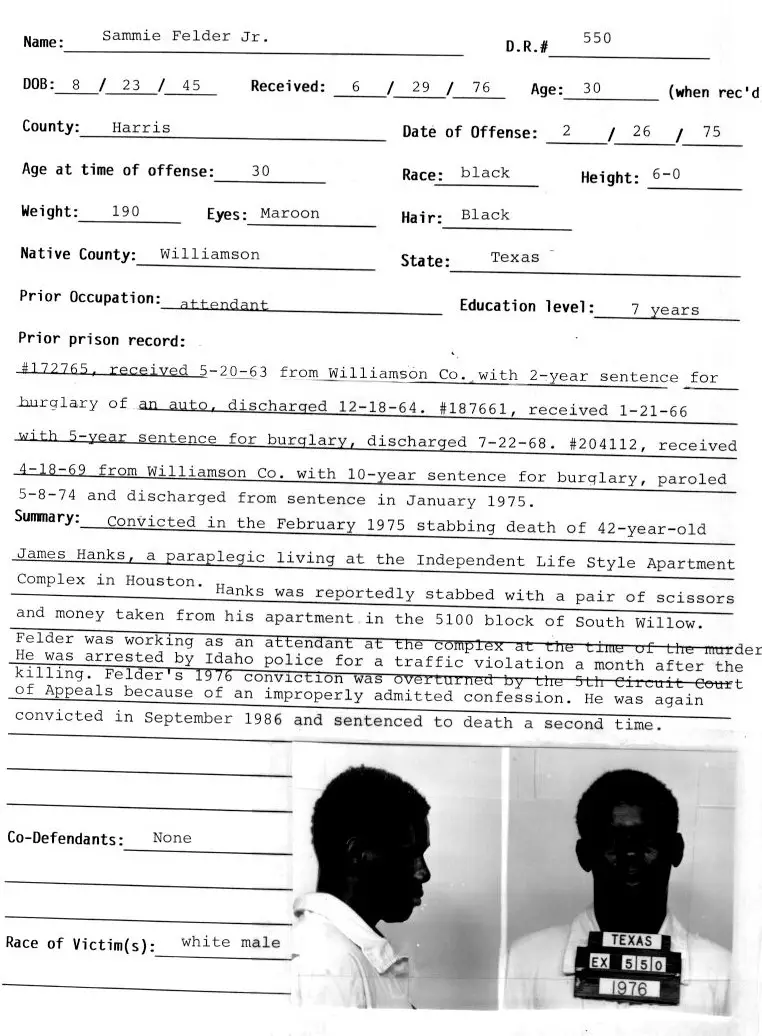
| Legal Identity | Sammie Felder Jr. |
| Confirmed Victims | 1 |
| Attributed / Indicted Victims | 1 |
| Active Timeline | 1975 |
| Jurisdiction / Area of Operations | Houston, Texas, USA |
| Criminological Classification | Murderer (Career criminal) |
| Forensic Modus Operandi | Use of improvised weapon (surgical scissors) during robbery |
| Weapon / Mechanism of Death | Stainless steel surgical scissors and mechanical asphyxia |
| Motive / Behavioral Dynamics | Robbery (Theft of wallet) |
| Judicial Outcome | Death penalty (Executed by lethal injection) |
1. Background and Profile
Sammie Felder Jr. was born on August 23, 1945. His criminal history began at age 14, characterized by a pattern of burglary and theft. Prior to the 1975 murder, Felder served multiple prison sentences for burglary between 1963 and 1975. His criminological profile is that of a career criminal whose violence escalated when faced with the risk of identification by his victims.
2. Criminal Career and Modus Operandi
On March 13, 1975, Felder, working as an orderly at a Houston apartment complex for the disabled, entered the room of James Hanks, a quadriplegic Korean War veteran. Felder intended to steal a wallet kept under the bed. When Hanks recognized him and called him by name, Felder grabbed stainless steel surgical scissors from a nearby tray and stabbed Hanks repeatedly in the head and throat. He also attempted to smother the victim with a pillow before fleeing with the stolen money.
3. Investigation and Arrest
Following the discovery of the unconscious victim, investigators identified Felder as a suspect after he failed to report to work. Felder fled to Denver, where he confessed the crime to an acquaintance, Edith Cobb, a civilian employee of the Denver Police Department. After Cobb reported the confession, Felder was arrested in Idaho in April 1975 for a traffic violation and false identification, leading to his extradition to Texas.
4. Legal Proceedings and Outcome
Felder's legal journey involved three separate trials. His first death sentence (1976) was overturned due to the improper admission of a confession obtained in violation of his Sixth Amendment rights. After a second conviction was overturned due to jury selection errors, he was convicted for a third time in 1989. The conviction was upheld by the Texas Court of Criminal Appeals in 1992.
5. Forensic Psychiatric and Final Outcome
Sammie Felder Jr. was executed by lethal injection on December 15, 1999, in Texas. In his final statement, he expressed remorse for the victim's death, though he maintained the killing was an impulsive act. His case remains a landmark in federal jurisprudence regarding the Sixth Amendment right to counsel during police interrogations.