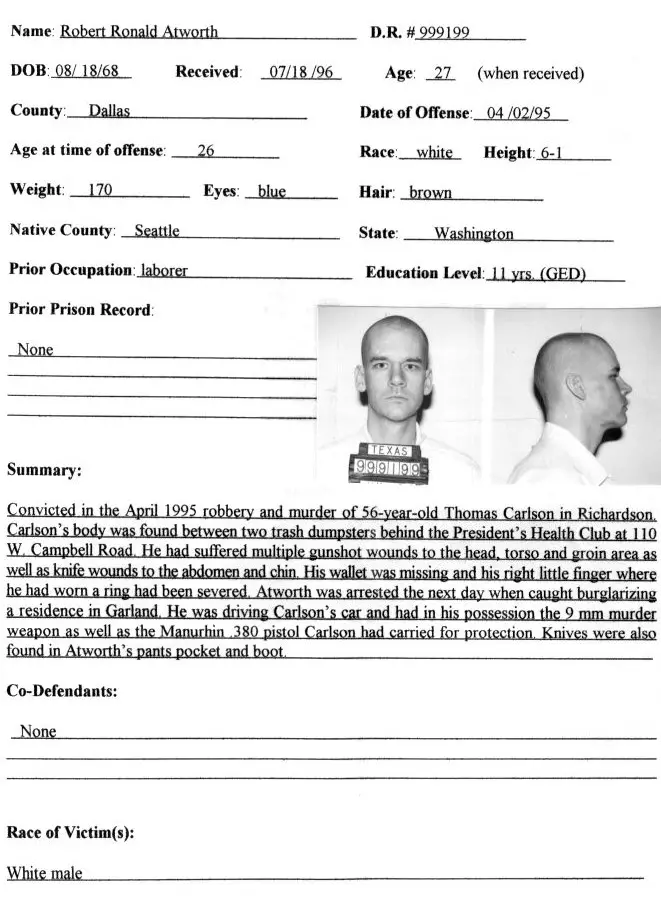





Forensic & Criminological Matrix
| Parameter | Forensic Detail |
|---|---|
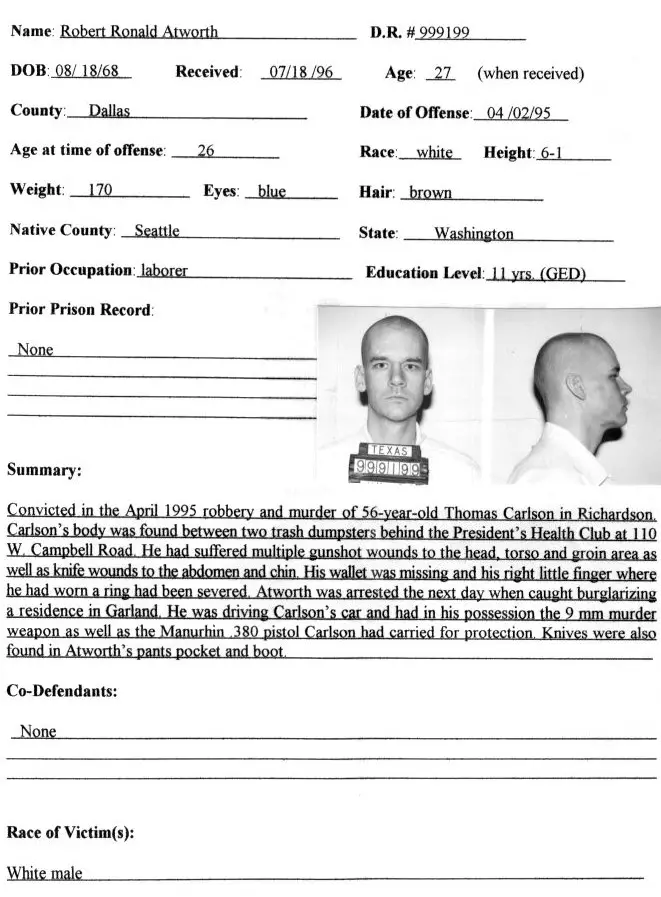
| Forensic Heading / Aliases | Robert Ronald Atworth |
| Legal Identity | Robert Ronald Atworth |
| Confirmed Victims | 1 (Thomas Carlson) |
| Active Timeline | April 1995 |
| Jurisdiction / Area of Operations | Richardson and Garland, Texas, USA |
| Criminological Classification | Robbery-homicide with sadistic/fetishistic trophy-taking |
| Forensic Modus Operandi | Police impersonation, ambush, overkill, and post-mortem mutilation |
| Weapon / Mechanism of Death | 9mm semi-automatic pistol and knife |
| Motive / Behavioral Dynamics | Pecuniary gain and paraphilic trophy collection |
| Judicial Outcome | Executed by lethal injection (December 14, 1999) |
1. Background and Profile
Robert Ronald Atworth (born c. 1969) had a prior criminal record in Florida involving narcotics and battery of a law enforcement officer. Criminological assessments described him as highly intelligent but exhibiting profound antisocial traits and a lack of empathy. His transition from minor offenses to a calculated, violent homicide suggested a rapid escalation in predatory behavior.
2. Crime Spree
On April 2, 1995, Atworth utilized a ruse of authority, impersonating a police officer to stop 56-year-old Thomas Carlson in Richardson, Texas. He diverted the victim to a secluded area behind a health club. Atworth shot Carlson four times and inflicted several stab wounds. In a display of clinical depravity, he severed the victim's right pinky finger to steal a ring, subsequently retaining the biological remains as a trophy.
3. Investigation and Arrest
Atworth was apprehended on April 3, 1995, in Garland, Texas, after a botched burglary attempt where he tried to enter a home through a dog door. Upon his arrest, police found him in possession of Carlson's personal effects and the murder weapon. A subsequent search of Atworth's residence revealed the victim's severed finger stored in a freezer, meticulously labeled with the date of the crime.
4. Legal Proceedings and Outcome
Atworth was convicted of capital murder. In 1999, he waived his right to further appeals, expressing a desire to expedite his execution. Psychiatric evaluations confirmed his competency to make this legal waiver. He was executed on December 14, 1999. His final statement was noted for its defiant and confrontational tone, reflecting his lack of remorse.