


Forensic & Criminological Matrix
| Parameter | Forensic Detail |
|---|---|
| Case File Designation | The Assassination of John F. Kennedy (Dallas Presidential Magnicide) |
| Primary Accused Perpetrator | Lee Harvey Oswald (aged 24, former U.S. Marine, Soviet defectee) |
| Exact Date of Assassination | November 22, 1963 (12:30 PM CST) |
| Geographic Jurisdiction | Dealey Plaza, Elm Street, Dallas, Texas, United States |
| Casualties & Victims | John Fitzgerald Kennedy (35th U.S. President, 46, fatal cranial trauma); John Bowden Connally Jr. (Governor of Texas, 46, severe multiple gunshot wounds); J. D. Tippit (Dallas Police Officer, 39, shot dead by Oswald 45 minutes later) |
| Identified Sniper's Perch | Sixth floor southeastern window, Texas School Book Depository building |
| Ballistic Weaponry Identified | Italian 6.5×52mm Mannlicher-Carcano Model 91/38 bolt-action rifle equipped with an Ordnance Optics 4x telescopic sight |
| Firing Sequence & Trajectory | Three shots discharged within 6.0 to 8.4 seconds; substantiation of the "Single Bullet Theory" by the Warren Commission |
| Suspect Outcome | Oswald was shot point-blank by nightclub owner Jack Ruby in the basement of Dallas Police Headquarters on November 24, 1963, dying hours later |
| Official Forensic Findings | Warren Commission (1964) concluded Oswald operated as a lone gunman without conspiracy; House Select Committee on Assassinations (HSCA, 1979) established a "probable conspiracy" involving a potential second shooter on the grassy knoll |
1. The Dealey Plaza Assassination (November 22, 1963)
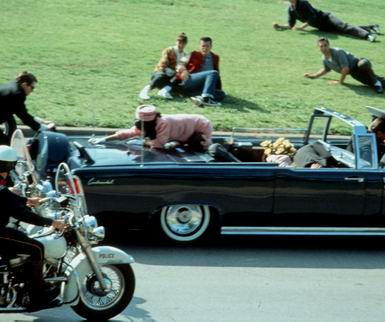
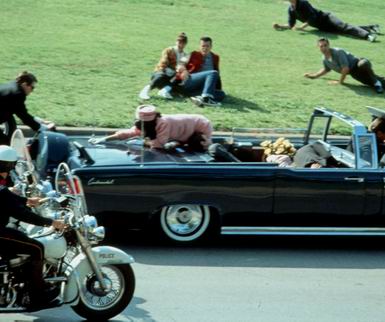
At 12:30 PM CST on November 22, 1963, President John F. Kennedy's open-top 1961 Lincoln Continental limousine turned off Houston Street onto Elm Street in Dealey Plaza, traveling at roughly 11 mph (18 km/h). Spectators lined the curb cheering the president and First Lady Jacqueline Kennedy:
- The First Penetrating Volley: As the motorcade moved past the Stemmons Freeway sign, the first shot was fired. The 6.5 mm round penetrated Kennedy's upper back, exited through the lower anterior trachea, pierced Texas Governor John Connally's right back, shattered his fifth rib, traversed his right wrist, and embedded into his left thigh (Commission Exhibit 399, the "Single Bullet").
- The Fatal Head Shot (Zapruder Frame 313): Seconds later, the fatal third projectile struck the right parietal-occipital area of Kennedy's skull. The impact destroyed extensive cerebral cortex and cranial bone, spraying biological matter across the trunk lid. Jacqueline Kennedy scrambled onto the rear hood as Secret Service Agent Clint Hill vaulted onto the vehicle to shield the presidential couple.
- Parkland Emergency Room: The motorcade sped toward Parkland Memorial Hospital. Despite emergency tracheostomy and external cardiac massage in Trauma Room 1, President Kennedy was pronounced dead at 1:00 PM CST.
2. Lee Harvey Oswald and the Slaying of Officer Tippit
Lee Harvey Oswald, born in 1939 in New Orleans, exhibited persistent personality maladjustment and alienation. Serving in the U.S. Marine Corps where he qualified as a marksman and sharpshooter, Oswald defected to the Soviet Union in 1959 under Marxist ideological conviction. Disillusioned with Soviet life, he repatriated to Texas in 1962 with his Russian wife Marina:
- Under the mail-order alias A. Hidell, Oswald acquired the 6.5 mm Carcano rifle and a snub-nosed .38 revolver.
- In April 1963, Oswald had attempted to assassinate retired right-wing Major General Edwin Walker in Dallas, firing into his home.
- In October 1963, Oswald secured employment as an order filler at the Texas School Book Depository, which stood along the presidential motorcade route.
- Following the shots, Oswald concealed his rifle between boxes of books, descended the rear staircase, and exited the premises before police cordoned the building.
- At 1:15 PM in Oak Cliff, Dallas Patrolman J. D. Tippit pulled alongside Oswald. Approaching on foot, Tippit was shot dead by Oswald with four point-blank .38 rounds.
- Oswald ducked into the nearby Texas Theatre, where he was subdued and arrested after attempting to draw his weapon on arresting officers.
3. The Jack Ruby Slaying
Throughout police interrogation under Dallas Police Captain Will Fritz, Oswald adamantly denied the assassinations, declaring to press microphones: "I didn't shoot anybody, no sir... I'm just a patsy."
On Sunday morning, November 24, 1963, at 11:21 AM, as Oswald was being escorted through the basement of Dallas Police Headquarters to an armored transfer vehicle, Jack Ruby (Jacob Rubenstein), a Dallas nightclub operator with organized crime ties, lunged forward from the media pool and discharged a single .38 caliber bullet into Oswald's abdomen.
The shooting was broadcast live on national television. Oswald suffered catastrophic internal hemorrhaging and was pronounced dead at Parkland Hospital at 1:07 PM.
4. Forensic Jurisprudence: Warren Commission vs. HSCA
The Dallas magnicide catalyzed the most intensive forensic review in modern judicial history:
- The Warren Commission (1964): Chaired by Chief Justice Earl Warren, the commission concluded that Oswald acted entirely alone from the sixth-floor depository window, that Jack Ruby acted independently, and that no credible foreign or domestic conspiracy existed.
- Forensic Disputes: Critics questioned the trajectory and pristine state of CE 399, the sudden rearward motion of the president's head captured on the Abraham Zapruder home movie, and conflicting acoustic accounts regarding Dealey Plaza's grassy knoll.
- House Select Committee on Assassinations (1979): The HSCA re-evaluated the physical evidence, concluding that while Oswald fired the fatal head shot and back wounds, acoustical recordings indicated with 95% scientific certainty that a fourth shot had been discharged from the grassy knoll, leading the committee to conclude that President Kennedy was "probably assassinated as a result of a conspiracy."